
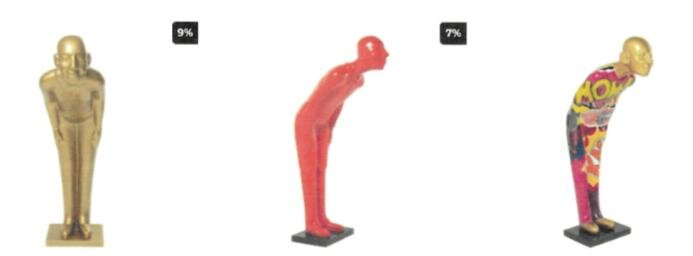
The claimant creates life-size sculptures of people of varying builds, leaning forwards, whose arms and hands rest against their bodies in various positions:
The defendant sells 164 cm tall decorative figures which also have a body leaning forwards and a bald head with a friendly facial expression, but where the shape of the head is more elongated than that of the plaintiff’s sculptures and which are available in various colours:
In its decision of 20 February 2026 (4 Ob 166/25b), the Supreme Court ruled that there was no infringement of copyright because the claimant could not prove that the defendant’s figures were adaptations of the claimant’s figures: Although these are works within the meaning of copyright law, an adaptation leaves the adapted work essentially unchanged, so that the original work reappears in its essential features in the adaptation (in contrast to ‘free use’). What is decisive is not whether a substantial part, in terms of scope and substantive significance, is borrowed, but whether the borrowed part of the work, as such, meets the requirements for copyright protection; if a part of a work lacks an individual character, then its use is permissible.
In the present case, the statues do not resemble one another in terms of head shape and facial expression. The posture of the defendant’s figures is characterised by a slimmer build than that of the plaintiff’s sculptures – it appears less stylised and thoroughly realistic. The plaintiff himself did not claim that the baldness of the statues constituted a protectable, intellectual-creative element. His application for an interim injunction was ultimately unfounded.